Healing Abundance, 1: We were fed
/ 10 min read
Table of Contents
What would you give to return to Eden? What would you give to never work a day in your life and have all of the food, medicine, building materials, and free time literally in the world available to you when you needed them? Would you trade it for an apple? What about for an iPhone?
We already made that trade. Twice.
The first trade: a piece of fruit — the original misdirection of the mandate, treating the sacred as a resource. The second trade: cobalt from the DRC, rare earth minerals from Myanmar, the labor of children as young as six, assembly workers in conditions requiring suicide prevention nets — for a device bearing the symbol of the first trade. Same logic. Same direction. The logo on the back of the phone is the confession hiding in plain sight.
The good news: in aggregate the damage is enormous; for each of us individually, the sins are small. So the healings are also small. The gate was never locked.
Stand outside.
If you have a yard, look at it. If you don’t, look at your nearest green space.
Now imagine you are in the Garden of Eden. Not the one in the paintings — not the one with the convenient fig leaf and the dramatic lighting. The real one. God’s actual design. The abundance that the Creator arranged before we got our hands on it.
What does it look like?
Does your Garden of Eden have a perfectly manicured lawn? Does it need to be mowed every Saturday? Does it require herbicide in the spring and fertilizer in the fall to stay green?
Or does it have fruit? Vegetables? Nuts? Berries? Animals moving through it? Medicine growing in the understory? Does it feed you without being asked?
Now look at your yard again.
What’s the difference? Who decided it should look like this? When did we agree — without being asked — that the correct relationship between a human being and a piece of land was weekly labor producing nothing edible, maintained at significant expense, on soil that would otherwise grow food without being asked?
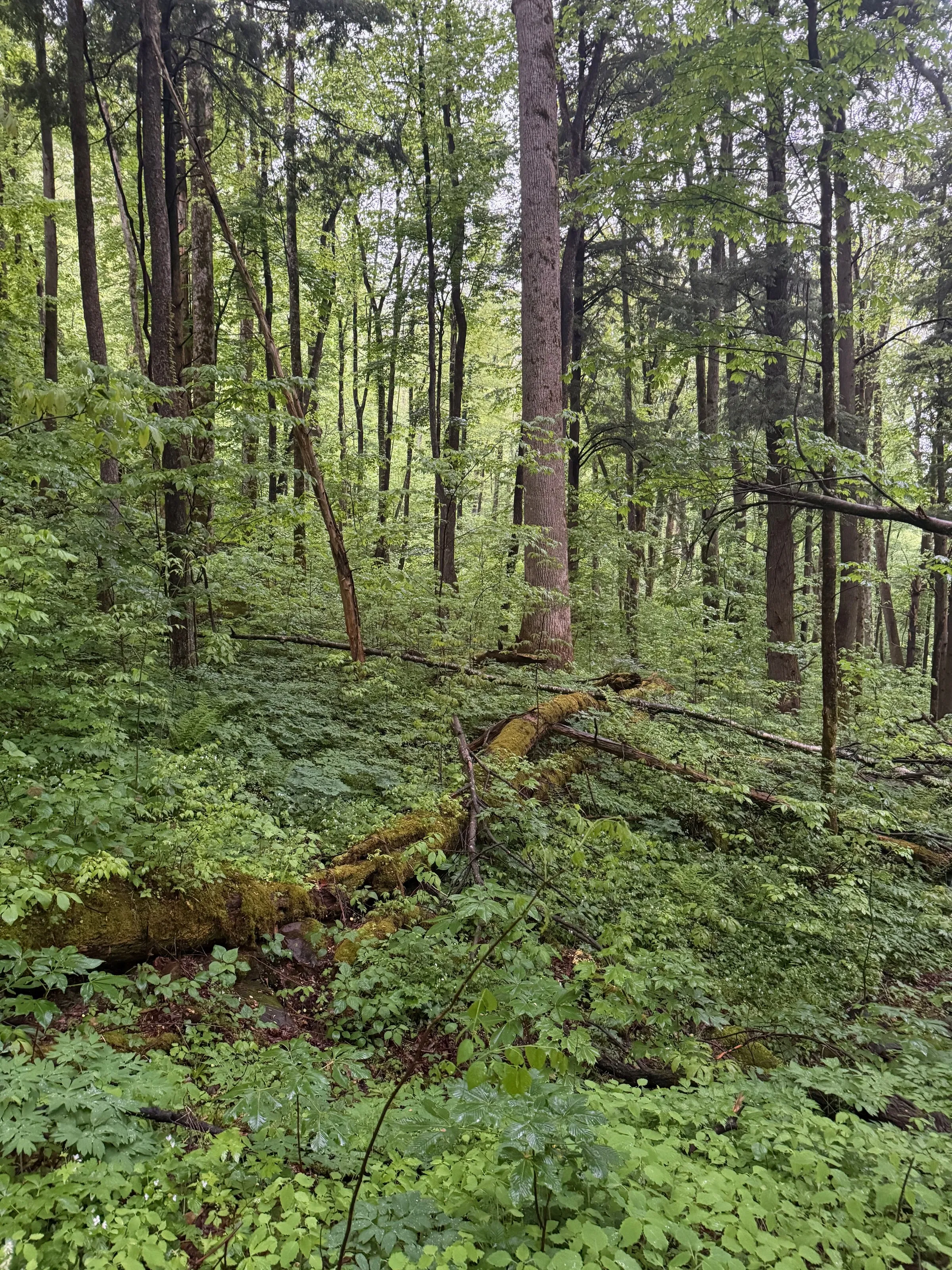
Great Smoky Mountains, rich cove ecosystem — ~99% indigenous plants visible, including food and medicine.
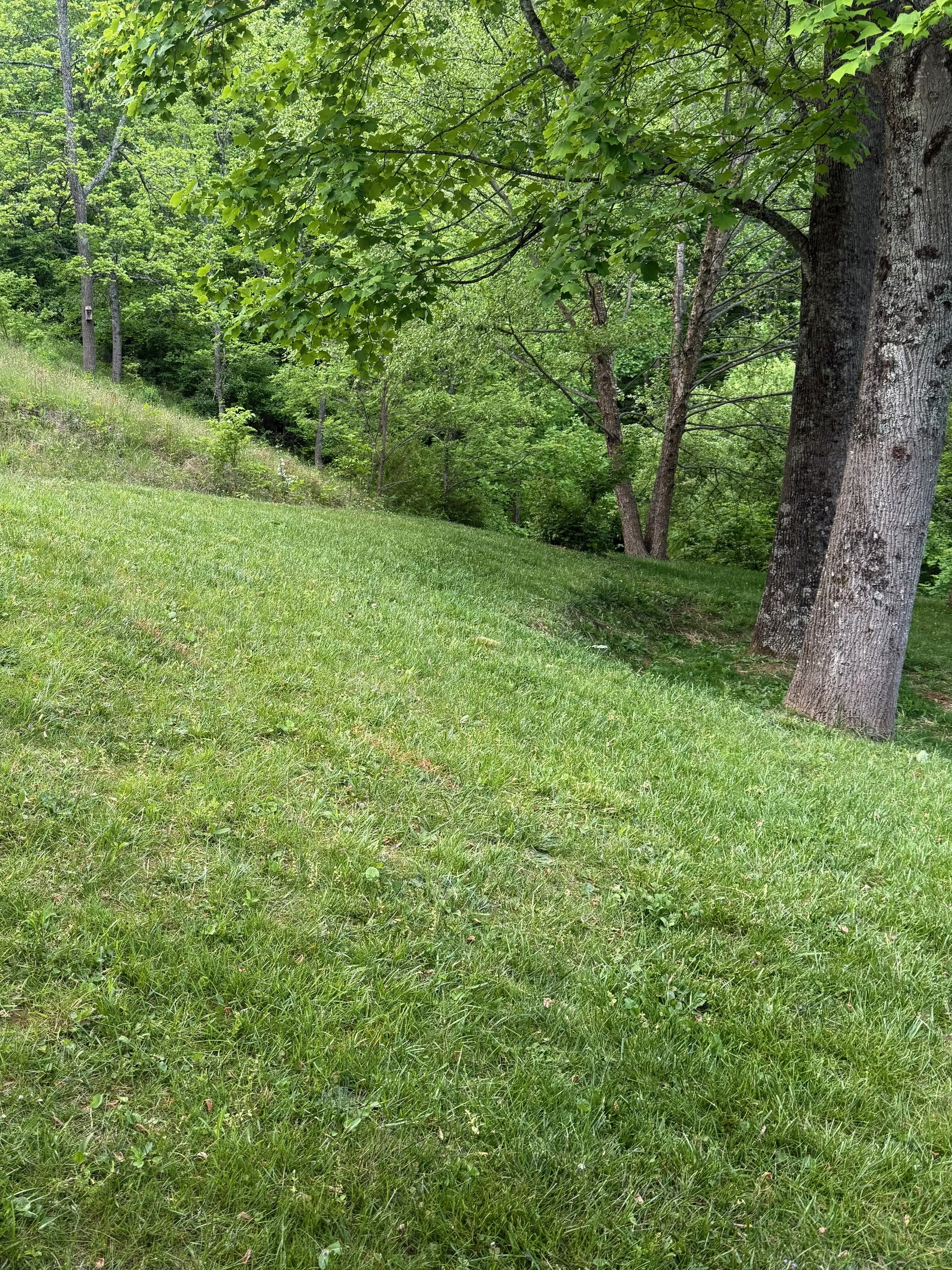
Same geology and hydrology with human intervention in Leicester, NC — ~80% indigenous plants visible, hardly any food, no medicine.
We have done this before.
I am reminded of a time when this was not the agreement. In 1944, American families were growing approximately 40% of the nation’s vegetables in victory gardens — more than 20 million home gardens producing real food from real soil, across cities and suburbs and rural communities simultaneously. The government encouraged it. The culture supported it. The land did it willingly.
After the war, the chemical companies that had been manufacturing explosives needed new markets for their nitrogen. The food industry needed customers who weren’t growing their own. The advertising industry needed a new aspirational image for the American home. Within a single generation, the victory garden was replaced by the lawn — and the lawn was sold not as what it is (a significant maintenance burden producing nothing) but as what it represents: prosperity, leisure, arrival. You are successful enough that you don’t need to grow food. You can buy it. The lawn is the proof. A rejection of the Creator’s designed abundance — for human design and human profit.
Zoning laws and homeowners associations institutionalized it. Herbicides like 2,4-D — developed and stockpiled as a chemical weapon at Camp Detrick during WWII — were repackaged for residential weed control and marketed directly to the people who had just spent four years growing their own food. The transition was swift, deliberate, and enormously profitable for everyone except the person pushing the mower. They went from tending and keeping to mowing, fertilizing, and applying poisons.
The same nitrogen manufacturers that had produced explosives — 10 ammonia plants built for WWII munitions — were redirected after the war to manufacture chemical fertilizer. The Muscle Shoals plant in Alabama switched from bombs to fertilizer in 1947. The infrastructure of war became the infrastructure of suburban agriculture.
After WWII, President Eisenhower said in his farewell address:
A vital element in keeping the peace is our military establishment. Our arms must be mighty, ready for instant action, so that no potential aggressor may be tempted to risk his own destruction… . American makers of plowshares could, with time and as required, make swords as well. But now we can no longer risk emergency improvisation of national defense; we have been compelled to create a permanent armaments industry of vast proportions… . This conjunction of an immense military establishment and a large arms industry is new in the American experience… . Yet we must not fail to comprehend its grave implications… . In the councils of government, we must guard against the acquisition of unwarranted influence, whether sought or unsought, by the military-industrial complex. The potential for the disastrous rise of misplaced power exists and will persist.
What Eisenhower warned about came to pass — but in a place we rarely think to look. Not just in the arsenals. In the front yard.
The American lawn is now the largest cultivated “crop” in the country. Roughly 40 million acres of turf cover an area approximately the size of Wisconsin — three times more land than is dedicated to irrigated corn. It covers more ground than any food crop in America. Onto it, we pour an estimated 9 billion gallons of water every day — roughly one-third of all residential water use in the United States. We spread on it nearly 80 million pounds of pesticide active ingredients and 90 million pounds of synthetic fertilizer per year; American homeowners use chemical pesticides at roughly ten times the rate that farmers apply them on cropland. Americans now spend approximately $76 billion a year on lawn care. None of it produces food. None of it produces medicine. None of it produces shelter. None of it produces anything at all.
Meanwhile, grocery prices have risen approximately 30% since December 2019, and the average American household now spends roughly a thousand dollars a month on groceries. The math of the victory garden has not changed since 1944. The land has not changed. The sun has not changed. We are spending more — far more — to maintain grass that feeds nothing than we would need to spend to feed ourselves from the same soil.
This is what scarcity actually looks like in production. Not absence. Not insufficiency. Active, expensive, continuous maintenance of the wrong outcome on land that wants to produce the right one. We are paying — heavily, generation after generation — to suppress abundance.
The lawn is not neutral. The lawn is a position. And it is not the position our Creator took.
The arithmetic of abundance.
The arithmetic isn’t theoretical. We already produce about 2,900 calories per person per day against a need of roughly 2,100 — and waste a third of it; over a billion meals a day land in the trash while 783 million people go hungry. We already manufacture more than 100 billion garments a year for 8 billion people; nearly a third are never sold. One in ten homes in the developed world sits empty — 42 million vacant units across the OECD — while 318 million people sleep without shelter. The medicines on the WHO Essential Medicines List can be generic-manufactured for pennies; one in four people still can’t get them. The problem is never supply. The problem is distribution — which is to say, it is a problem of who decides what gets sent where, and why.
The trade we made for the iPhone runs in the opposite direction. We would exhaust Earth’s lithium reserves before giving everyone an iPhone and an electric car. The math doesn’t work. The math has never worked. We have built a civilization whose central aspirational object cannot be universally distributed even in principle, on a planet that already produces enough to feed, clothe, house, and heal every person on it.
This is not an oversight. This is our design.
What we lost. What is still here.
New York Harbor was once surrounded by 220,000 acres of oyster reefs — roughly the combined landmass of all five boroughs — containing nearly half of the world’s oysters. The Lenape ate them for millennia without depleting them. Within three hundred years of European arrival, the reefs were gone. The harbor that once filtered itself through the work of trillions of bivalves now requires billion-dollar engineering projects to approximate what the oysters did for free.
This pattern repeats. The biomass of wild mammals has fallen to roughly one-seventh that of livestock; plant biomass has been halved since the rise of human civilization. The world is not running out of capacity. The world is being prevented from expressing the capacity it still has.
And yet — and this is the heart of it — the damage is repairable. A single restored acre of perennial polyculture, modeled on the oak savanna, produces nearly twice the human-edible calories of an acre of corn, with no annual planting, no synthetic fertilizer, no pesticide, and a soil profile that improves rather than degrades. The land remembers how to do this. It has been waiting for permission.
The thesis.
This series is the long form of a single argument, approached from four directions:
The mathematical case: that abundance, not scarcity, is the default state of any healthy living system, and that scarcity is something we have to actively produce and maintain. The theological case: that the texts we have read as commands to dominate were, in their original languages and ecological contexts, instructions to tend and keep — and that the Bible is partly a fossil record of indigenous ecological knowledge that lost its methodology when it lost its relationship to the ecotone. The ecological case: that every functioning natural system is a feedback loop optimized for abundance, and that the five toxic patterns we have built our civilizations around — patriarchy, imperialism, ethno-religious supremacy, colonialism, and extractive capitalism — are each natural phenomena scaled past their functional range. And the neurobiological case: that the human nervous system, given the conditions it actually evolved for, defaults to rest, repair, and connection — not to the perpetual threat-response we have come to mistake for adulthood.
These four converge on a single conclusion. The sins are small. The healings are small. The work is not punishing labor. The work is the letting go of the things we have placed in the way of what the land, the body, and the spirit already want to do.
Effortless healing, not punishing labor.
The gate was never locked.
We walked away from the garden. We can walk back.
That’s the whole series, in ten words.
The articles that follow will take this apart slowly — the etymology, the ecology, the systems theory, the math, the theology. And the practical work: what restoration actually looks like on a piece of land in Western North Carolina, in Leicester, in the cove forests of the Southern Appalachians. Some of the oldest plant communities in North America. One of the oldest mountain ranges in the world. Still doing exactly what they were designed to do.
The lawn is a recent invention. The garden is older than memory.
We were fed once. We can be fed again.